Sweepstakes vs Online Casinos US: Legal Differences 2026
 Available in US
Players who’ve used both types of platform often describe them as feeling nearly identical. The games look similar, the mechanics behave similarly, the wins and losses feel real. And yet the legal and regulatory frameworks governing them are so different that they might as well be different industries. Understanding that gap is useful not just academically — it determines what protections you have, what oversight exists, and why AMOE exists as a feature of one but not the other.
Regulatory Frameworks and US Licensing Distinctions
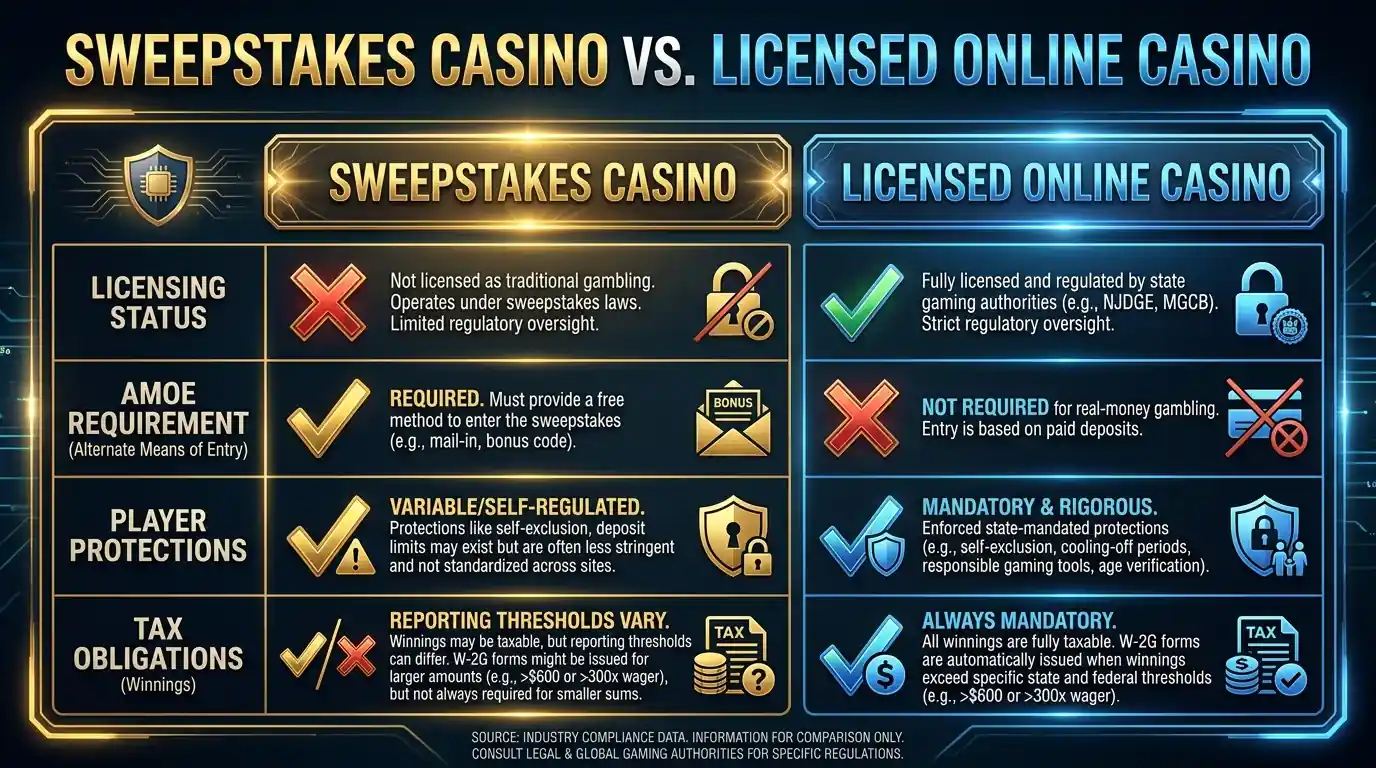
Regulated online casinos in the United States operate under gambling licenses issued by state gaming control boards. As of 2024, real-money online gambling was legal and licensed in seven states. Licensing imposes a comprehensive compliance framework: technical audits of random number generators, minimum payout percentages, anti-money-laundering controls, problem gambling safeguards, responsible gaming tools, and consumer protection requirements enforced by a regulatory agency with real enforcement authority.
The regulated iGaming sector generated $8.41 billion in revenue in 2024 — entirely within those seven states. Compare that to sweepstakes casinos, which operated in most of the country without state gaming licenses and generated over $10.6 billion in gross purchases in the same year. The sweepstakes sector captured the equivalent of roughly 13% of the total commercial gaming industry’s revenue without participating in the licensing framework that governs that industry. That asymmetry is the source of nearly every policy debate about sweepstakes casinos, and it’s the context for the 2025 legislative wave that restricted operations in six states.
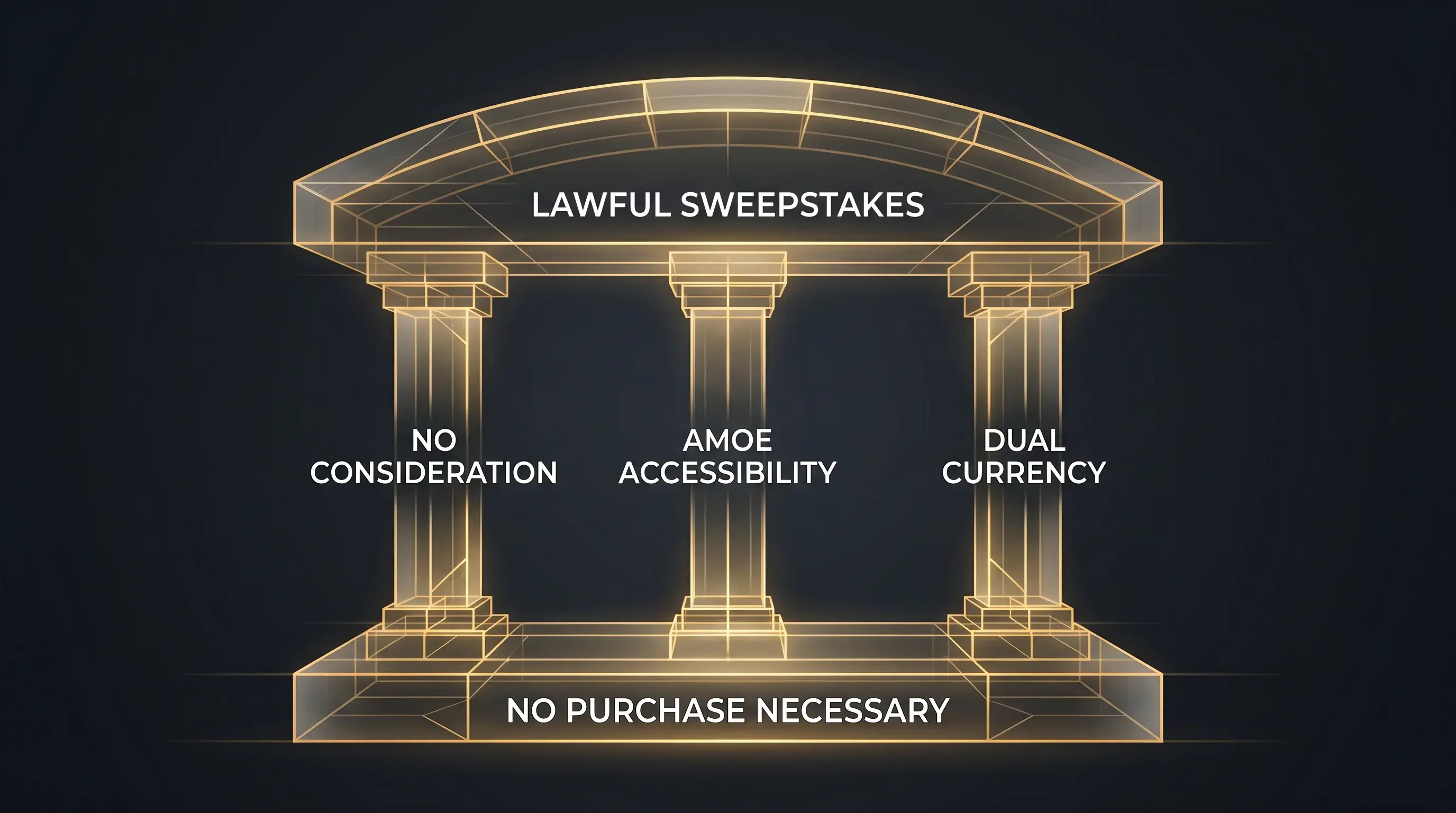
The sweepstakes legal model rests on the three-element test for illegal lotteries: consideration (purchase), chance (random outcome), prize (something of value). Remove consideration by providing a genuine free entry pathway — AMOE — and the promotion becomes a lawful sweepstakes rather than an illegal lottery. This is structurally elegant from a legal standpoint, and it’s been legally sustainable in most jurisdictions for years. But it creates a regulatory environment where an industry generating tens of billions in revenue operates with minimal consumer protection requirements and no gaming taxes, which is exactly what regulators and licensed competitors objected to in 2025.
Gameplay, Odds, and Player Protections Compared
On the surface, the games are similar. Slot mechanics, card games, and other casino-style games appear at both licensed casinos and sweepstakes platforms. The key gameplay difference is in what “winning” means and whether the outcomes are independently verified.

Licensed online casinos are required in most jurisdictions to have their games certified by independent testing laboratories — organizations like eCOGRA or GLI that verify that the random number generators produce genuinely random outcomes and that the stated payout percentages are accurate. The payout percentages for licensed online casino games are typically in the 94-97% range, meaning the house edge is 3-6% on average. These figures are audited and published.
Sweepstakes casinos have no equivalent independent certification requirement in most jurisdictions. Estimated payout rates for sweepstakes casino SC gameplay range in the 68-72% range based on available industry analyses — a significantly lower effective return than licensed casino games. Whether this difference is real or reflects methodological differences in how payout rates are calculated for the two models is contested, but independent verification is substantially less available for sweepstakes game outcomes than for licensed gambling outcomes.
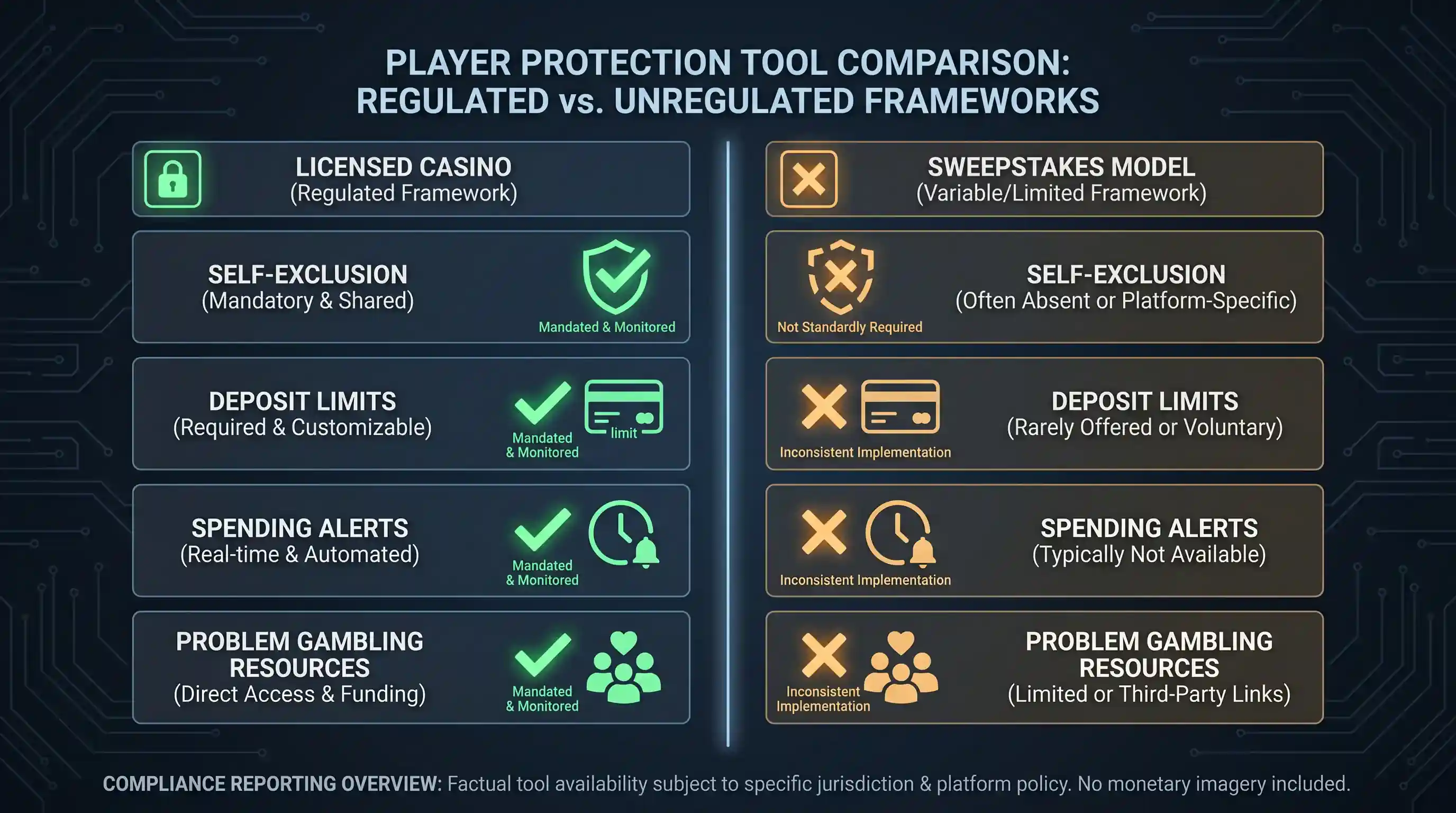
Player protections represent the starkest contrast. Licensed casinos are required to offer self-exclusion programs, deposit limits, spending alerts, and access to problem gambling resources — these aren’t optional features but mandatory compliance elements. Sweepstakes casinos typically offer some voluntary responsible gaming tools, but they’re not required to provide the same safeguards. When the American Gaming Association noted that 80% of sweepstakes casino players spend money monthly, with nearly half doing so weekly, in the absence of these protections, the consumer welfare concern was explicit.
How Winnings and Redemption Differ
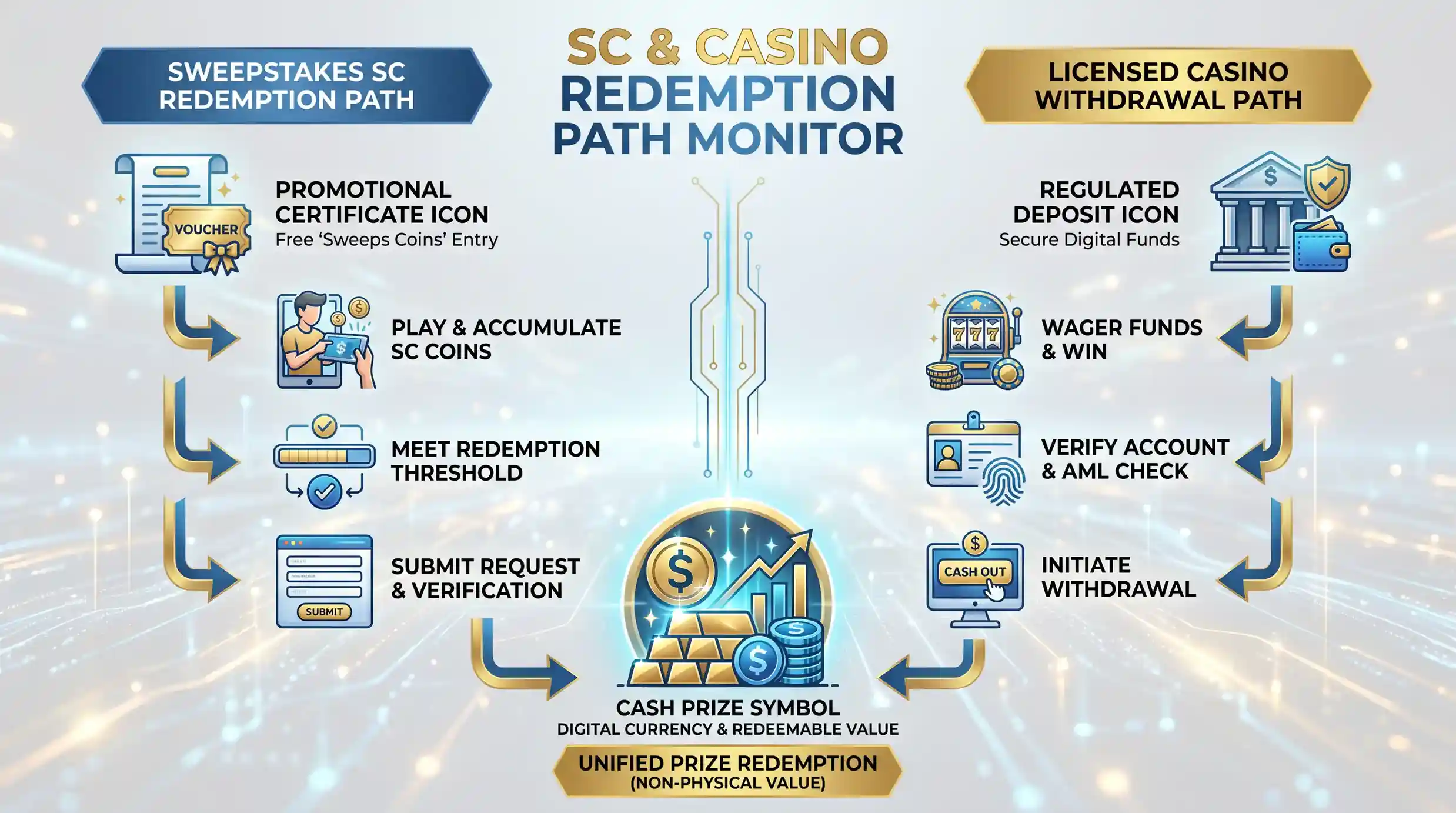
At a licensed online casino, when you win money, you’ve won money. Your balance is in real currency, withdrawable subject to standard KYC verification and processing times. The legal classification of your winnings as gambling income for tax purposes is clear and consistent. The casino’s obligation to pay you is governed by the gaming license and can be enforced through the relevant regulatory body if payment is withheld.
At a sweepstakes casino, when you “win” while playing with Sweeps Coins, you receive more SC. Those SC can be redeemed for cash prizes, but the redemption is governed by the operator’s Sweepstakes Rules, not by a gaming license. The operator’s obligation to honor redemption requests is contractual — it’s in the terms — but there’s no licensing body with jurisdiction to enforce it if the operator doesn’t comply. Unredeemed SC are promotional credits, not deposits; they have no independent legal protection.
The tax treatment of sweepstakes prize winnings is technically the same as any sweepstakes: cash prizes above IRS reporting thresholds are taxable income, and operators are required to issue 1099 forms for applicable winnings. But the framing of the transaction as a sweepstakes prize rather than gambling winnings creates some definitional complexity that players should be aware of when calculating tax obligations.
Why AMOE Exists Here but Not There
AMOE is a structural requirement for sweepstakes casinos and absent from licensed casinos because the two models rest on different legal foundations. Licensed casinos explicitly sell the right to participate in gambling — consideration is the point, and it’s licensed by the state. Sweepstakes casinos can’t do this without a gaming license, so instead they sell entertainment (Gold Coins) and provide a free promotional pathway (AMOE) that keeps the platform in sweepstakes territory rather than gambling territory.
A licensed online casino doesn’t need AMOE because it doesn’t need to satisfy the NPN requirement — there’s no three-element lottery test to satisfy when you’ve already obtained legal authorization to conduct gambling. AMOE is a legal workaround for platforms that can’t or don’t want to pursue gambling licensing, not a feature that betting operators independently chose as a good player experience. Its existence at sweepstakes casinos is entirely a function of their legal architecture.
This explains why the quality of the AMOE program is such an important signal of operator legitimacy. An operator whose AMOE is genuine, accessible, and well-functioning has built a product whose legal foundation is credible. An operator whose AMOE is nominal, buried, or unreliable has a legal foundation that begins to look like a facade — which is exactly the argument being made in dozens of regulatory proceedings and lawsuits in 2025 and 2026. For the complete legal structure behind this, the detailed guide to the sweepstakes casino legal model covers how the NPN architecture works and where it’s been challenged.
Sweepstakes vs. Regulated Casino: Common Questions
Do sweepstakes casinos offer worse odds than regulated online casinos because they don’t need to meet payout standards?
Based on available analysis, the effective return on SC gameplay at sweepstakes casinos — estimated in the 68-72% range — is lower than the typical 94-97% payout rates certified at licensed online casinos. Whether this gap reflects different game mechanics, different accounting methodologies, or genuinely lower player returns is difficult to determine independently because sweepstakes casino games are not subject to the same mandatory certification requirements as licensed games. The absence of independent verification requirements is itself a meaningful difference between the two models.
Can a regulated online casino also offer an AMOE-based sweepstakes promotion?
Technically yes — a licensed casino could run a sweepstakes promotion with an AMOE as a separate marketing activity, as many consumer companies do. What it cannot do is operate its core gaming product under a sweepstakes structure as an alternative to a gaming license, because the state licensing requirement applies to the gambling activity itself regardless of how the entry mechanism is structured. Some licensed operators have experimented with sweepstakes-adjacent features, but the core real-money gambling product requires a license, period.
Published by the Alternate Method of Entry Sweepstakes team.