
Mail-In AMOE Request US: Correct Postcard Format
 Available in US
Nine years in sweepstakes compliance, and the question I get asked more than any other is not about legal structures or wagering terms. It is simply: “I sent a postcard two weeks ago and nothing showed up — what did I do wrong?” The answer, almost every time, is something fixable. A missing account username. A postcard printed instead of handwritten. An envelope sent when the operator wanted a postcard. Small things that the operator’s processing team uses to reject entries without a second look.
Mail-in AMOE — alternate method of entry — is the legal mechanism that lets sweepstakes casinos operate under U.S. promotional law. If an operator accepts Gold Coin purchases, they must also accept free entry requests by mail. That is non-negotiable. But “accepting” a request and actually crediting your account with Sweeps Coins are two different things, and the gap between them is almost always caused by a format error that could have been avoided.
This guide covers exactly what goes in the envelope, what format works, what the complete process looks like from first stamp to credited coins, and where most people go wrong. Most operators award between 1 and 5 Sweeps Coins per request and process in 7 to 14 business days under normal conditions, though delays can push that to six or eight weeks during high-volume periods. One request per day per household is the standard across the industry. If you know those numbers going in, the rest is just execution.
Table of Contents
- Essential Postcard Requirements and Handwriting Rules
- Postcard or Envelope: Format and Size Requirements
- The Complete Mail-In Process: From Writing to Waiting
- Daily Limits, Household Rules, and Frequency Caps
- Processing Window: When Will the Coins Arrive?
- Mistakes That Get AMOE Requests Rejected
- Mail-In AMOE: Your Questions Answered
Essential Postcard Requirements and Handwriting Rules
Before sending your request, ensure you meet all the AMOE postcard size and format requirements to avoid automatic rejection by the operator.
For more comprehensive strategies and operator comparisons, return to our main sweepstakes casino AMOE guide.
I have reviewed enough rejected AMOE requests over the years to know that operators are not being arbitrary. Their processing centers handle thousands of pieces of mail per week, and they use a checklist. If your postcard or letter does not check every box, it goes in the reject pile — not because anyone is trying to cheat you out of free Sweeps Coins, but because a human or automated system cannot match your request to your account without the right information.

Every AMOE request, regardless of operator, needs to include the same core elements: your full legal name, your mailing address (the one on file with your account), your date of birth, your email address associated with the account, and your account username or player ID. That last one is where I see the most failures. People assume the email address is enough to identify them. It is not. Most operators have multiple accounts tied to the same domain. Your username or player ID is the unique identifier that routes the request to the right account.
Beyond the account identifiers, you need to include the specific request phrase the operator requires. This varies by platform. Some operators want you to write “Please enter me in the current sweepstakes promotion.” Others have a specific phrase on their Terms and Conditions page. Before you write a single word on a postcard, check the operator’s official rules — usually found in the footer under “Sweepstakes Rules” or “Promotions Terms.” Copy the required language exactly. Do not paraphrase it.
The sequence matters too. Most operators who process by hand scan the top of the card first. Lead with your username, then your legal name, then your email, then your address, then your date of birth, then the required phrase. That ordering mirrors what their checklist expects. If the information is scattered across the card with no clear structure, the processor has to search for it — and some operators simply reject entries where the information is not easy to locate.
New York players have an additional requirement worth noting. Because New York regulations impose a higher standard for what counts as a genuine alternate entry method in digital promotions, many operators who accept mail-in requests elsewhere also require a separate online AMOE form submission from New York residents. Check the operator’s terms for your state specifically — do not assume the mail-in alone is sufficient if you are in New York.
Postcard or Envelope: Format and Size Requirements
Here is something that surprises people: most sweepstakes operators actually prefer postcards over envelopes. Not because postcards are harder to send — they are not — but because postcards are cheaper for the operator to process. A postcard goes through a different USPS handling pipeline, and for operators running high-volume AMOE programs, that efficiency matters. When in doubt, use a postcard unless the operator’s rules specifically say “envelope.”
USPS defines a standard postcard as measuring at minimum 3.5 inches by 5 inches, and at maximum 4.25 inches by 6 inches. The thickness must be between 0.007 and 0.016 inches — basically, card stock. Anything smaller will not qualify as a postcard under USPS pricing rules; anything larger becomes a “large postcard” or a letter and gets priced and routed differently. The 3.5 x 5 index card that most people have lying around is almost exactly the right size.

When an operator does accept envelopes, use a standard #10 business envelope (4.125 by 9.5 inches) or a letter-size envelope (minimum 3.5 by 5 inches, maximum 6.125 by 11.5 inches). Include a single sheet of paper with all required information — do not fold a postcard inside an envelope, which creates ambiguity about format compliance. Write on the paper, not on card stock, and keep it to one page.
One format detail that causes rejections more often than it should: the requirement for handwriting. Virtually every sweepstakes operator requires that the request be handwritten, not printed. The reason is legal — a handwritten request demonstrates individual human action, which supports the “no purchase necessary” legal structure. Printed requests, typed text, or peel-and-stick labels on the written content section of the card are typically grounds for rejection. Your address label on the outside of an envelope is fine printed; the actual request content must be in your handwriting.
Ink color does not matter — blue and black both work fine. What matters is legibility. If a processor cannot read your username because your handwriting is cramped or smeared, the request fails. Write clearly and leave enough space between lines. A 3.5 x 5 postcard has limited real estate, which is another reason the username comes first — if you run out of space, at least the identifier is there.
The Complete Mail-In Process: From Writing to Waiting
Let me walk through this in the order I would do it myself, because the sequence makes a difference in avoiding errors.
Before you write anything, pull up the operator’s current AMOE rules. Find the exact mailing address — not the company’s corporate address, not the customer support address. The AMOE processing address is often different from all of those, and it changes periodically. Operators update their addresses when they switch processing centers, and sending a request to an outdated address is a guaranteed non-delivery. Verify the address on the day you plan to mail, not the day you last checked it two months ago.
Once you have the current address, gather your materials: a blank postcard or sheet of paper and envelope, a pen, and a first-class stamp. At current USPS rates, a postcard stamp is slightly cheaper than a letter stamp — another reason postcards make sense. Write your information on the card or paper in the order outlined earlier: username, full legal name, email address, mailing address, date of birth, required request phrase. Double-check every field. Username errors alone account for a significant share of rejections.
Address the postcard on the other side: the operator’s AMOE address goes in the center, your return address goes in the top left corner. A return address is technically optional under USPS rules for postcards, but I always include one. If the card is undeliverable for any reason, a return address means it comes back to you rather than disappearing. For envelopes, your return address in the top left is standard and expected.
Affix a postcard stamp (for postcards) or a first-class letter stamp (for envelopes). Drop it in a USPS collection box, hand it to a postal carrier, or take it to a post office counter. Certified mail is overkill for AMOE requests and does not speed up processing on the operator’s end. Regular first-class mail is sufficient. Do not use courier services or overnight delivery — the operator’s mail room is not set up for it, and it may cause routing issues.
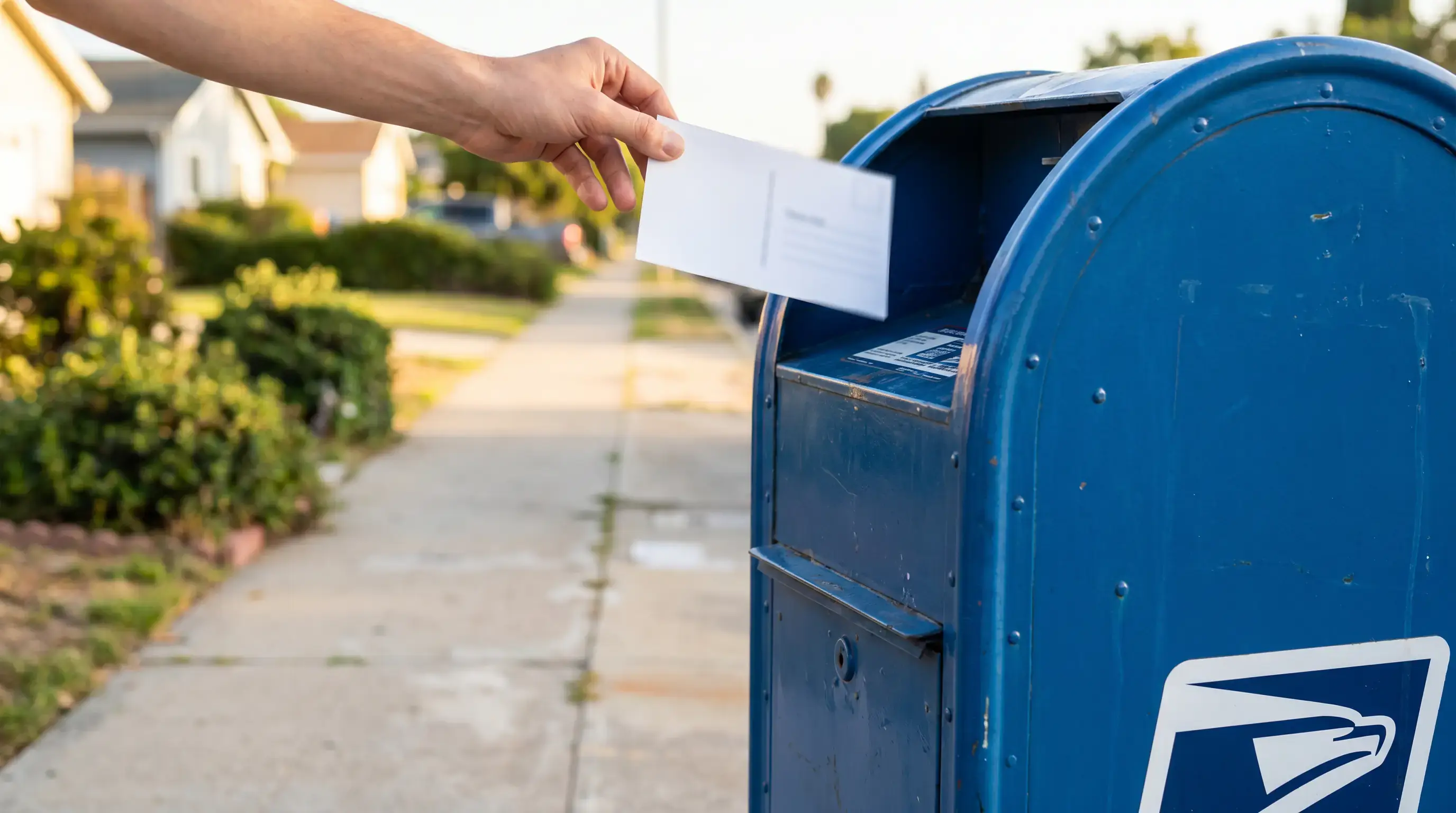
From the moment your request hits the mail, processing time runs 7 to 14 business days in most cases — that is calendar weeks two through three under normal conditions. Mark your calendar for the end of that window. If coins have not appeared after 14 business days, check your account carefully. Sometimes credits show up without notification. If there is still nothing after 21 business days, contact the operator’s customer support with your mailing date and all the information you included on the request. Keep a record of what you sent and when.
Daily Limits, Household Rules, and Frequency Caps
The one-per-day rule is almost universal across the industry, and it applies per household, not per person. That second part is the one that catches people. You and your spouse both have accounts at the same operator, you both send requests on the same day from the same address — most operators will credit one and reject the other, or in some cases reject both for the duplicate household violation.
A “household” in operator terms is defined by the mailing address on file with your account. If two accounts are registered to 123 Main Street, Unit 4, that is one household. One request per day from that household is the limit, regardless of how many accounts exist at that address. Some operators define household more strictly — by shared IP address, shared payment method, or shared device — but for mail-in AMOE, the mailing address is the controlling factor.

The daily limit resets at midnight based on the date your request is received, not the date you mail it. If you mail on Monday but the request arrives Wednesday, Wednesday is the date that counts. You could technically mail a request on Monday and another on Tuesday, and both would process as separate daily entries because they arrive on different days. In practice, the postal system is inconsistent enough that I would not try to optimize around arrival dates — focus on building a consistent daily routine, one per day per household, and let it accumulate over time.
Some operators add a monthly household cap on top of the daily limit. Read the full promotional rules, not just the AMOE summary. A monthly cap of 30 requests in a 31-day month effectively means the same as the daily cap, but a monthly cap of 15 or 20 would limit you significantly. Monthly caps are less common than daily caps but not rare. If you are planning a systematic multi-operator strategy, knowing each operator’s monthly ceiling helps you allocate your time and postage budget accurately.
As legal counsel familiar with sweepstakes compliance has noted, any operator attempt to hide, complicate, or penalize AMOE use is a direct violation of federal promotional law and a serious warning sign. The household rule is legitimate — operators have to prevent gaming of the system. But if you find an operator whose AMOE rules are buried in a 40-page document, whose address is hard to locate, or whose processing times routinely exceed eight weeks without explanation, those are signals worth paying attention to. For a deeper look at what makes an AMOE program legitimate versus one that is designed to fail, see our guide on sweepstakes casino AMOE red flags.
Processing Window: When Will the Coins Arrive?
Two weeks in, no coins, starting to wonder if you did something wrong. I hear this constantly. The honest answer: maybe you did, maybe you did not, and the processing window makes it hard to know yet.
The standard processing window is 7 to 14 business days from receipt of your request. “Business days” excludes weekends and federal holidays, which means a request received on a Friday before a holiday weekend could sit for five calendar days before anyone touches it. A request mailed Monday that arrives Thursday and gets processed the following Tuesday has already eaten eight business days just in transit and queue time, before anyone has actually read it.
Delay scenarios that push processing beyond 14 business days are real and documented. The most common are high-volume periods — promotional events, new operator launches, and the weeks around major holidays when operators run special sweepstakes. Some operators explicitly state a 6 to 8 week processing window during promotions. Check the operator’s current rules for any notice about extended processing timelines before assuming your request was lost or rejected.

A second common cause of delay is address changes. When an operator moves their processing center, mail sent to the old address gets forwarded, which adds days or weeks depending on USPS forwarding efficiency. This is why verifying the address on the day you mail is not paranoia — it is practical.
If your coins do not appear after 14 business days under normal conditions, here is what I recommend: log into your account and check the promotions or rewards history section. Many platforms log incoming AMOE credits without sending an email notification. The coins may be there without any alert reaching your inbox. If the account shows nothing after 21 business days, contact support with the details of your submission. Document what you sent, when you mailed it, and what you wrote. Support teams at reputable operators can often look up processing records by mailing date and account username.
Mistakes That Get AMOE Requests Rejected
After years of reviewing rejection patterns across multiple operators, a clear picture emerges. The same errors come up over and over, and none of them are difficult to avoid once you know what the processing team is checking for.
The most common single cause of rejection is a missing or incorrect account username. Not the email address — the username or player ID. These are different fields, and processors use the username as the primary lookup key. If your username is wrong, or if you left it out entirely because you thought your email was enough, the processor cannot link your request to an account. The request gets rejected or discarded.

Second most common: printed text on a required-handwritten request. I have covered this already, but it bears repeating because it surprises people. If you printed a template, filled in the blanks by hand, and mailed it, that may still fail. Some operators consider any printed element on the request content as disqualifying. The safest approach is always a blank card, all handwritten from scratch.
Third: wrong address. This one hurts more than the others because the request might be delivered to an old processing center, sit in a mail room, and never get forwarded to the right department. Always confirm the current AMOE processing address from the operator’s official website or terms document on the day you mail.
Fourth: duplicate household entries. Two requests from the same address on the same day — or in some cases, the same week if the operator has tighter restrictions. Review the household rules for each operator before establishing a routine.
Fifth: illegible handwriting. This sounds trivial, but processors working through thousands of cards per week do not spend time deciphering unclear handwriting. Write slowly and clearly. If your natural handwriting is difficult to read, print each character individually rather than using cursive. Clarity beats style every time.
Sixth: missing information fields. Every required field must be present. If the operator requires your date of birth and you left it off, the request is incomplete. Before mailing, run through a mental checklist: username, full name, email, mailing address, date of birth, required phrase. If you are not certain you have everything, check the operator’s rules one more time.
Seventh: wrong format — for instance, using an envelope when the operator explicitly requires a postcard, or vice versa. This is less common than the other errors, but it does happen. When operators say “postcard,” they mean postcard. A letter in an envelope is a different postal item and may be routed to a different processing queue, or simply rejected on format grounds.
Mail-In AMOE: Your Questions Answered
Does my AMOE postcard have to be handwritten, or can I print it?
Virtually every sweepstakes operator requires the request content to be handwritten. Printed text — whether typed and printed or filled into a template — is typically grounds for rejection because handwriting demonstrates individual human action, which supports the legal ‘no purchase necessary’ structure. Your return address label on the outside of an envelope can be printed, but the actual request information on the card or inside the envelope must be in your own handwriting.
Can I send more than one mail-in AMOE request per day to a single operator?
No. The standard industry rule is one request per household per day to a given operator. Sending multiple requests in the same day to the same operator will typically result in one being credited and the rest rejected — or in some cases, all of them rejected for the duplicate violation. This limit applies to your household address, not just your individual account, so if multiple people at the same address hold accounts with the same operator, coordinate to avoid sending on the same day.
What happens if I forget to include my username on the AMOE postcard?
Your request will almost certainly be rejected or left unprocessed. The username or player ID is the primary field that allows the operator’s processing team to match your request to your account. An email address alone is insufficient because many operators have multiple accounts associated with the same email domain. If you realize you forgot your username after mailing, send a corrected request the following day — your daily limit will have reset.
Is there a maximum number of AMOE requests allowed per month per household?
Some operators impose a monthly household cap on top of the daily limit. Monthly caps vary and are not universal — many operators only enforce the daily limit. To find out whether a specific operator has a monthly ceiling, check the full promotional rules document rather than just the AMOE summary. Monthly caps of 15 to 30 requests are the range I see most often when they do exist.
Published by the Alternate Method of Entry Sweepstakes team.