Real Costs of AMOE Requests US: Stamp and Mail Expenses
 Available in US
Every compliance attorney I’ve worked with tells the same version of the same joke: sweepstakes entry isn’t free, it’s just cheap. They’re not wrong. The “no purchase necessary” standard in U.S. sweepstakes law doesn’t require zero cost to the entrant — it requires no purchase of the operator’s product. Postage costs you money. Cardstock costs you money. Your time costs you something. None of that makes the AMOE illegal, but it does mean the word “free” in sweepstakes marketing is doing a lot of work.
I think players deserve a clear-eyed accounting of what a mail-in AMOE request actually costs, what they get back, and whether that math makes any sense. The answer is more nuanced than either “totally free” or “not worth it.”
Calculating Total Expenses Per Sweepstakes Mail-In
If you want to maximize your free Sweeps Coins without spending on postage, you should compare mail-in requests with daily login bonuses and social media promotions.
Find the most profitable platforms to play on by visiting our expert sweepstakes casino directory.
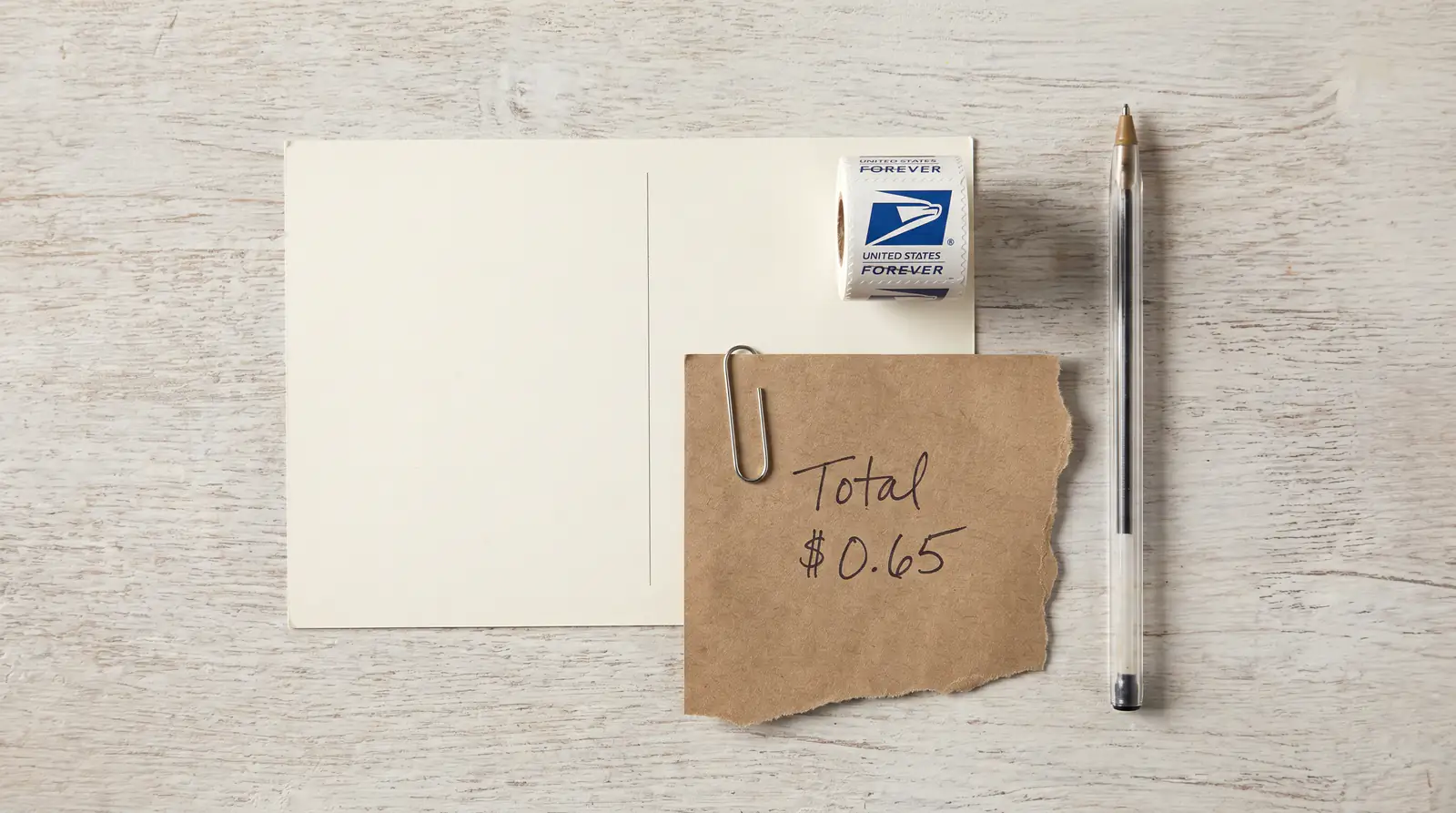
Let me give you the honest breakdown before anything else. As of 2026, the most common costs associated with a single AMOE submission are: a postcard or notecard (roughly $0.05 to $0.15 per card if purchased in bulk, higher for individual purchases), first-class postage for a standard postcard (currently $0.56 for USPS postcard rate as of the current schedule), and the time to write and mail it (two to five minutes).
The total out-of-pocket cost per request lands somewhere between $0.60 and $0.75 depending on what you already have on hand. If you’re buying a pack of 100 postcards and a book of stamps, you’re looking at roughly $60 to $70 in upfront cost to send 100 requests. That translates to about $0.65 per submission on average.
There’s also the time component, which varies by player but shouldn’t be ignored. Writing, addressing, and mailing a postcard takes around three to five minutes if you’ve done it before. At 30 requests per month (the daily maximum at a single operator), that’s roughly 90 to 150 minutes per month just in writing time — before accounting for trips to the mailbox. If you’re optimizing across multiple operators, the time multiplier matters.
Stamps vs. Sweeps Coins: The ROI Calculation
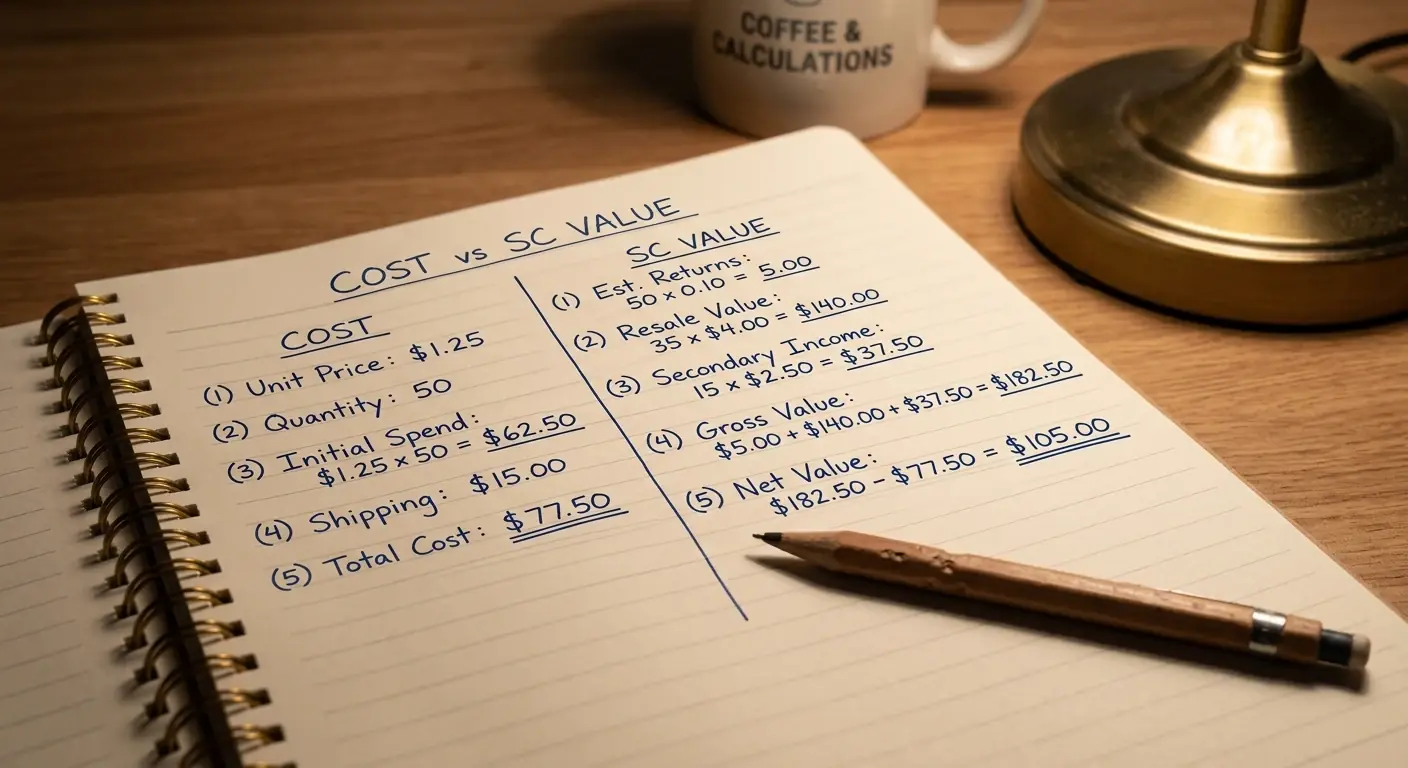
Here’s where the math gets interesting. The industry standard for Sweeps Coins awarded per AMOE request ranges from one to five SC, with most operators sitting at the lower end of that range. At one SC per request and a standard redemption rate of $1 per SC (a common benchmark, though operators vary), a single AMOE submission returns $0.65 to $0.70 worth of redeemable currency against a $0.65 out-of-pocket cost.
That’s roughly break-even at one SC, and meaningfully positive at two or more SC per request. The ROI improves as operators increase their AMOE award amounts, but the math also depends heavily on whether you actually redeem. Sweeps Coins that sit unused in an account accrue no value — only redeemed coins represent real-world return on your postage investment.
The calculation shifts when you’re looking at volume. A player submitting daily AMOE requests to a single operator at $0.65 per submission over 30 days spends $19.50 and receives 30 to 150 SC depending on the award rate. At a $1 per SC redemption standard, that’s $30 to $150 in redeemable value against $19.50 in costs — a positive return in the range of 1.5x to 7.7x for consistent, maximum-frequency participants. Those numbers look good until you factor in processing delays, which are real and documented: the standard window of seven to fourteen business days means your monthly submission batch won’t be fully credited in the same month you mail it.
I want to be clear that these figures use the industry standard range for illustrative purposes. Individual operator award amounts vary, and the $1 per SC redemption benchmark is a simplification — actual redemption rates and minimums vary by platform. The directional math holds, but specifics require checking each operator’s current terms.
Why the Law Still Considers AMOE “Free”
The legal definition of “free” in sweepstakes context is precise and deliberately narrower than ordinary usage. Under sweepstakes law across all 50 states, a promotional sweepstakes becomes an illegal lottery if it requires three elements simultaneously: consideration (payment or purchase), chance (random selection), and a prize. Remove any one of those elements and it’s no longer a lottery.
The “no purchase necessary” rule — which operates under FTC guidelines and parallel state-level statutes — specifically addresses the consideration element. By providing a free method of entry that doesn’t require purchasing the operator’s product, sweepstakes casinos eliminate consideration from the equation. The cost of a stamp is not “consideration” in the legal sense because it’s not a payment to the operator for anything — it’s a third-party transaction with the postal service.
As one legal analysis of sweepstakes compliance puts it, any attempt by an operator to obscure, complicate, or penalize use of the AMOE constitutes a direct violation of federal law and a serious warning sign for users. The legal protection only works if the AMOE is genuinely accessible — not buried in fine print, not contingent on purchasing first, not subject to artificial restrictions that make it impractical to use.
So: postage costs money, your time costs something, and yet the entry is legally “free” because the cost is incidental rather than a purchase of the sweepstakes product. That’s the technical answer. The practical answer is that you’re paying a small amount for something that may return a small positive value — not nothing, but not the unconditional freebie that marketing language implies.
Volume Requests: Does the Math Improve at Scale?

If you’re thinking about optimizing the economics, the key variables are: number of operators you participate with, award SC per request at each operator, actual redemption rate per SC, and your time value. The scale math improves meaningfully on the financial side when you find operators offering higher SC amounts — two or three SC per request instead of one shifts the break-even point considerably. Spreading participation across multiple operators (each allowing one request per day) multiplies the total opportunity without exceeding any individual operator’s household limits.
The scale math gets harder on the time side. Managing AMOE submissions across five or ten operators involves tracking five or ten different addresses, five or ten different required information formats, and waiting for five or ten different processing timelines. The organizational overhead can easily outweigh the incremental SC gains unless you build a systematic routine.
There’s a broader comparison worth making here. If optimizing free Sweeps Coins is your goal, AMOE is one of several methods available — and not always the highest-yield one depending on the operator. The comparison of AMOE against daily logins and other free methods covers this in more detail. The short version: AMOE tends to be more consistent than social media promotions and less time-intensive per SC than referral programs, but daily login bonuses at high-volume operators can produce comparable SC without postage costs.
AMOE Cost Questions Answered

Does the cost of postage affect whether AMOE counts as ‘no purchase necessary’ under the law?
No. Postage is a cost incurred in a transaction with the U.S. Postal Service, not a payment to the sweepstakes operator. U.S. sweepstakes law defines ‘consideration’ as something given to the operator in exchange for the chance to win — purchasing a product, service, or entry. Paying for postal delivery of an independent entry does not satisfy that definition. Courts and regulators have consistently treated the postage cost as incidental to AMOE participation rather than consideration under the three-element lottery test.
Are there sweepstakes casinos that offer a genuinely cost-free digital AMOE alternative?
Yes. Some operators offer web form or email-based AMOE options that require no postage and no physical materials. These digital entry methods, when available, represent the closest thing to truly free participation. However, not all operators offer them, and in some jurisdictions the legal requirements for digital AMOE differ from mail-in. New York, for example, established a higher standard for digital promotions that mail-in AMOE alone does not satisfy. Always verify what methods are currently available and valid in your state before relying on any specific entry format.
Prepared by the Alternate Method of Entry Sweepstakes editorial staff.