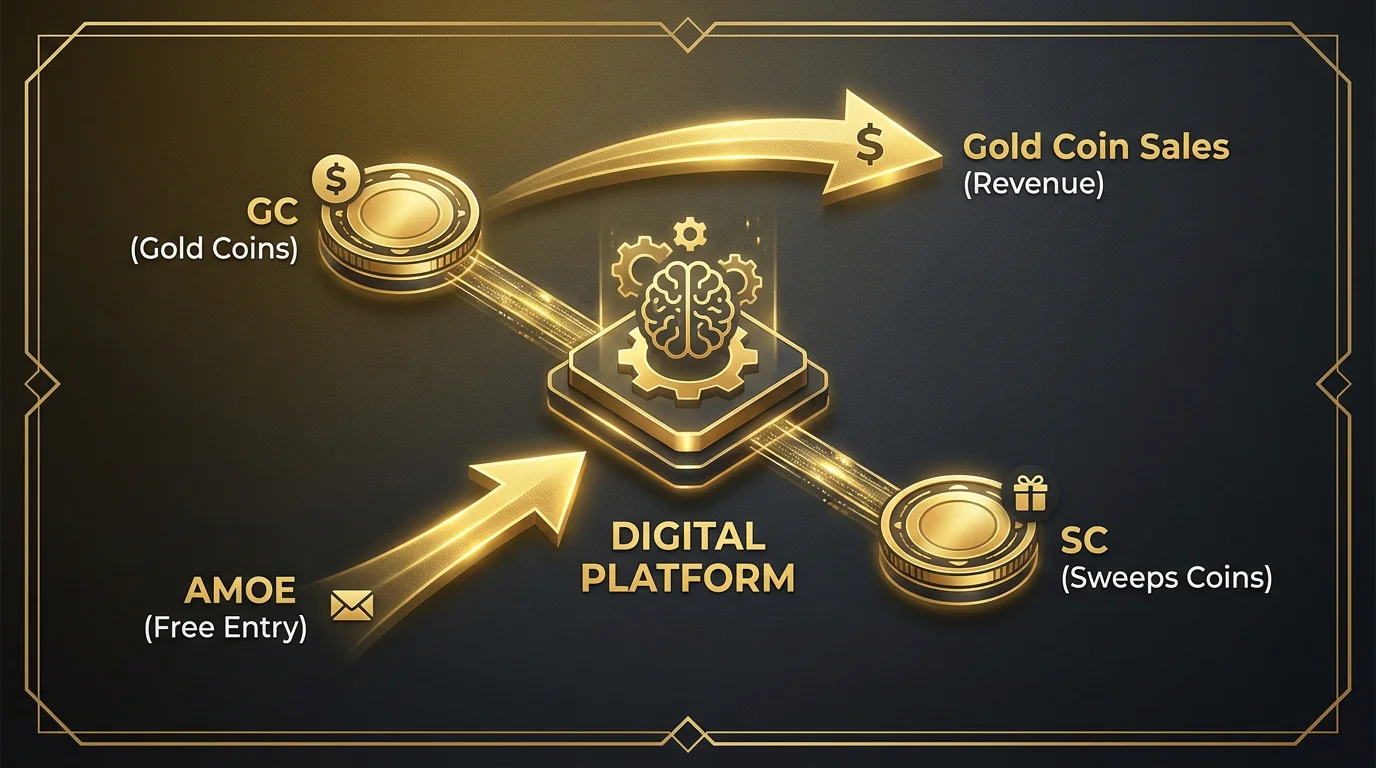
AMOE Sweeps Coins by Operator US: Top Payouts
 Available in US
The first time I tried to calculate how much a mail-in AMOE request was actually worth, I ran into the same wall everyone does: the numbers vary wildly by operator, and most platforms do not advertise their AMOE coin amounts anywhere obvious. You have to dig into the terms, track down a processing address, mail a request, wait, and then see what shows up. That experience is by design — not necessarily malicious design, but deliberate design. Understanding why the amounts differ is the first step to building a realistic picture of what AMOE is actually worth as a strategy.
The industry standard range for Sweeps Coins awarded per single mail-in AMOE request sits between 1 SC and 5 SC. That range has been consistent for several years and reflects an economic calculation on the operator’s side that I will explain in detail below. One request per household per day is the universal cap. At 1 to 5 SC per request, the monthly ceiling for a single-operator strategy runs from roughly 30 SC to 155 SC — before accounting for rejections, processing delays, and any monthly caps the operator imposes on top of the daily limit.
What does the fastest-growing segment in U.S. gaming — a sector that generated over $10 billion in gross Gold Coin purchases in 2024 alone — have to gain by keeping AMOE coin amounts this low? The answer is where the interesting economics live. The sweepstakes market did not reach its current scale by being generous with free coins. It reached it by keeping enough free players engaged long enough for a small but valuable fraction to convert into paying customers. AMOE is one of the main engagement hooks for that free-play majority, and the coin amounts reflect that strategic positioning.
Table of Contents
- Standard Industry Mail-In SC Amounts and Timelines
- Operator Comparison: SC per Request and Processing Time
- Why Operators Set Low AMOE Amounts: The Conversion Math
- Which Operators Process AMOE the Fastest?
- What Are Sweeps Coins Actually Worth When You Redeem?
- How to Maximize Monthly SC Income Through AMOE Alone
- AMOE Coins and Operator Details: Common Questions
Standard Industry Mail-In SC Amounts and Timelines
Pull up the terms for a dozen different sweepstakes operators and you will find the same 1-to-5 SC range appearing again and again. It is not a coincidence or an industry cartel — it is the product of independent operators arriving at similar conclusions about what makes economic sense for a program that they are legally required to offer but are not commercially motivated to promote.
On the low end, 1 SC per request is the floor you will find at larger, more established operators. These platforms have the highest volumes of AMOE requests because they also have the largest user bases, and they calibrate the coin amount to manage total liability. One SC has real redemption value — most operators price 1 SC at approximately $1 in redemption terms — so awarding even 1 SC per request to tens of thousands of daily mailers represents a meaningful cost line. A platform with 50,000 active AMOE participants sending one request daily is looking at 50,000 SC in daily liability, or roughly $50,000 in potential redemption exposure per day. Keeping the per-request amount at 1 SC contains that number at a manageable level.

On the high end, newer or smaller operators sometimes offer 3, 4, or 5 SC per request as a competitive differentiator. A platform trying to build its user base may set a generous AMOE amount to attract the cost-conscious player segment — the 88% of sweepstakes users who never make a purchase. The economics work for a smaller platform because the total volume of requests is lower. As the operator scales, AMOE amounts often come down.
There is also a category of operators who award bonus coins for the first AMOE request from a new account. This is distinct from the ongoing daily AMOE amount. A first-request bonus of 10 or 20 SC on top of the standard 1 to 2 SC per subsequent request is a player acquisition mechanism, not ongoing AMOE generosity. Once the new-account bonus is gone, the ongoing rate applies. Read the full terms to distinguish between one-time and recurring AMOE rewards.
Operator Comparison: SC per Request and Processing Time
Rather than naming specific operators and current coin amounts — which change without notice and would make this section stale the moment any operator updates their terms — I want to give you a framework for evaluating what you are actually looking at when you check an operator’s AMOE program. Because the comparison is not just about SC per request. Processing time is equally important, and the relationship between the two reveals a lot about how seriously an operator takes their AMOE program.
Operators who credit 3 to 5 SC per request and process within 7 to 10 business days are running a compliant, well-resourced AMOE operation. The higher coin amount signals that the operator views AMOE as a legitimate player acquisition channel — which it is, when run properly — and the fast processing time means they have staffed and systematized the operation adequately for their volume.
Operators who credit 1 SC per request and consistently take 5 to 6 weeks to process are technically compliant but are not treating AMOE as a real acquisition channel. They are meeting the legal minimum. That is not grounds for complaint — legal minimum is still legal — but it informs your calculation of whether the time and postage cost is worth it for that particular operator.
A third category exists: operators whose AMOE amounts and addresses are difficult to find in the terms, whose processing times are not disclosed, and whose support team cannot tell you anything about processing status. These are the programs worth scrutinizing most carefully. Difficulty accessing the AMOE program is one of the clearest signals that an operator is running a nominal program rather than a genuine one. For a detailed breakdown of how to identify and evaluate operator AMOE quality, the guide on how to send a mail-in AMOE request covers the practical side of what to look for in operator terms before you mail anything.
For current address information by operator, I maintain a separate reference. Addresses change when operators switch processing centers, and a wrong address means a lost request. Verify before you mail.
Why Operators Set Low AMOE Amounts: The Conversion Math
Only 12% of sweepstakes casino users ever make a Gold Coin purchase. That number comes from Eilers and Krejcik Gaming, one of the few research firms that publishes data on the actual purchasing behavior of the sweepstakes player base. Eighty-eight percent play for free, forever, using AMOE and daily login bonuses and social media promotions. From a traditional gaming perspective, that sounds like a terrible business. From a sweepstakes operator perspective, it is the foundation of the model.
The 12% who do purchase are extraordinarily valuable. Average monthly Gold Coin purchases tend to be small — often under $10 per transaction — but the frequency compounds. An operator’s revenue model depends on converting a small fraction of the free-play base into recurring purchasers, and AMOE is one of the mechanisms for keeping free players engaged long enough for that conversion to happen.
Average revenue per user in the sweepstakes sector grew at 17% annually between 2020 and 2024. That growth rate reflects both an expanding user base and improving conversion from free-play to paid. The AMOE amount is calibrated in this context: high enough that free players feel the program is worth engaging with, low enough that the operator’s Sweeps Coin liability does not outpace Gold Coin revenue from the converting minority.
Think of it as a loss leader calculation with specific math. If 1,000 users send daily AMOE requests at 2 SC each, that is 2,000 SC per day in liability. If 5% of those users eventually convert to purchasing Gold Coins at an average of $20 per transaction, twice per month, the purchasing revenue from 50 users — $2,000 per month — more than covers the AMOE coin cost if Sweeps Coins redeem at approximately $1 each. The math is tight but workable for the operator, which is why the 1-to-5 SC range exists rather than, say, 20 SC per request.

Which Operators Process AMOE the Fastest?
Processing speed is the variable most underweighted by players when they evaluate AMOE programs. A 3 SC per request program that processes in 7 business days outperforms a 5 SC program that consistently takes 6 weeks, simply because the faster program delivers predictable, timely access to coins you can actually use.
Based on processing windows disclosed in operator terms and reported by players over time, larger platforms with established operations tend to process faster — 7 to 10 business days is standard. Smaller or newer operators sometimes process faster initially when request volumes are low, then slow down as their user base grows and AMOE volume outpaces their processing capacity. Mid-size operators with dedicated AMOE processing infrastructure are often the most consistent.
The standard industry window is 7 to 14 business days. Any operator whose terms state a processing window of 30 to 60 days should be evaluated carefully — that is at the outer edge of what players experience, and it significantly reduces the practical value of the program. If your coins are locked in a 6-week processing queue, you cannot use them to play the games you are interested in, which undermines the purpose of accumulating AMOE coins in the first place.
Delays beyond the stated window are a separate issue from a long stated window. An operator who says “7 to 14 business days” and consistently delivers in 20 is running into operational issues — whether that is insufficient staffing, address changes that are causing mail delivery problems, or software issues in their crediting system. Contact support when processing exceeds the stated window, document your request details, and escalate if the first response does not resolve the issue.
What Are Sweeps Coins Actually Worth When You Redeem?
The standard redemption rate across the industry is approximately 1 SC to $1 in prize value — but the actual experience of redemption is more complicated than that ratio suggests. Sweeps Coins can typically be redeemed for cash prizes, gift cards, or in some cases cryptocurrency, and the specific options and minimum thresholds vary significantly by operator. Cash redemption via bank transfer or PayPal is the most common mechanism at established operators; gift card options tend to have lower minimum thresholds but also lower flexibility in how you spend the value.
Minimum redemption thresholds are the first constraint. Most operators require a minimum balance of 50 to 100 SC before redemption is available. If you are earning 1 to 2 SC per day through AMOE alone, reaching 100 SC takes 50 to 100 days of consistent mailing — roughly 2 to 3 months. That timeline is real and should inform how you think about AMOE as a strategy. It is a slow accumulation play, not a fast-cash mechanism. The players who benefit most from AMOE are those who approach it as a supplement to regular sweepstakes activity, not the sole source of their Sweeps Coin balance.

Playing through Sweeps Coins before redemption is another requirement at most operators. You cannot simply receive AMOE coins and immediately cash them out. The coins need to be wagered at least once — played through the sweepstakes games — before the resulting balance becomes redeemable. This playthrough requirement is typically one times the AMOE coin amount, meaning if you receive 2 SC, you need to play through at least 2 SC worth of game activity before those coins convert to redeemable prize credits. Some operators set higher playthrough multiples for free-received coins versus purchased coins. If a specific operator applies a 3x playthrough to AMOE coins but only 1x to purchased coin bonuses, the effective value of each AMOE Sweeps Coin drops proportionally — factor that into your per-operator calculation.
The real value of a Sweeps Coin in play depends on the game’s return-to-player rate. Payout rates at sweepstakes casinos typically run in the 68 to 72% range, which means every SC you play through in the games has an expected return of about 68 to 72 cents. Over thousands of plays, that rate governs how your balance moves. AMOE coins are worth 1 SC in face value but less in expected value once you account for the required playthrough. The face value still represents the coin’s redemption floor — if you play through the minimum requirement and still have your original balance, you redeem at full value. But if the games consume more than they return during your playthrough — which is statistically likely — your redeemable balance will be lower than the face value of the AMOE coins you received.
How to Maximize Monthly SC Income Through AMOE Alone
The ceiling on a single-operator AMOE strategy is clearly defined: one request per household per day, 1 to 5 SC per request, 30 to 31 days per month. At maximum generous operator rates, a household can accumulate 100 to 155 SC per month from a single platform. That is meaningful — $100 to $155 in face redemption value over 30 days, with zero purchasing required. At the more common 1 to 2 SC rate, the monthly accumulation from a single operator runs 30 to 60 SC, which is still above the minimum redemption threshold at many platforms.
Multi-operator AMOE strategies multiply that ceiling. If you maintain accounts at five operators, each with a one-per-household daily limit, and each awarding 2 SC per request, a household can accumulate 10 SC per day, roughly 300 SC per month across all accounts. This requires five separate mailings per day, five sets of processing addresses to maintain, and five accounts to track — but it also multiplies the accumulation rate proportionally. Some players run even broader strategies, maintaining accounts at eight to ten operators simultaneously, though the administrative overhead grows proportionally and postage costs start to eat into returns.
The practical constraint is postage cost and time. At current first-class postcard rates, five daily postcards costs about $1.65 to $2.00 in postage per day. Over 30 days, that is approximately $50 to $60 in postage to accumulate roughly 300 SC at 2 SC per request per operator. The net SC income after postage cost is approximately 240 to 250 SC in redemption value, assuming no rejections and standard processing. That is still a positive return on the postage cost, but the margin is tighter than the face value of the coins suggests. At 1 SC per request across five operators, the math gets tighter — roughly 150 SC gross, 90 to 100 SC net of postage, which may or may not justify the daily effort depending on your approach.
One practical optimization that players often overlook: batch your postcard writing. Sit down once a week and write out seven postcards for each operator you use. Date them appropriately so you are not sending multiples on the same day, and mail them daily. This separates the cognitive load of writing from the physical act of mailing, and it prevents the routine from feeling like a daily chore that needs fresh mental effort every morning. Pre-written cards in a stack make consistency much easier to maintain.

The stronger argument for multi-operator AMOE is diversification rather than pure SC maximization. Different operators have different games, different redemption options, and different minimum thresholds. Distributing your AMOE activity across multiple platforms gives you more flexibility in how and when you access Sweeps Coins. It also hedges against an operator updating their AMOE terms, changing their address, or pausing their program — which all happen periodically in this industry. When one operator’s program is temporarily unavailable due to a processing center move or a terms update, your SC accumulation continues across the other platforms in your rotation.
There is also a strategic argument for keeping at least one “anchor” operator with a higher SC-per-request amount — say 3 to 5 SC — even if their processing time is slightly slower, paired with two or three “volume” operators at 1 to 2 SC but faster crediting. The anchor builds your balance fastest; the volume operators keep regular coin flow coming in on a shorter cycle. This layered approach balances SC accumulation rate against the practical benefit of having coins available to play on a consistent schedule.
AMOE Coins and Operator Details: Common Questions
Do AMOE Sweeps Coins expire if I do not use them quickly?
Expiration policies vary by operator and are detailed in each platform’s terms and conditions. Some operators set a 90-day inactivity expiration on Sweeps Coins balances — meaning if you do not log in or play for 90 days, your coin balance may be forfeited. Others have no expiration on Sweeps Coins as long as your account remains in good standing. Check the specific terms for each operator you use. Regular account activity — even logging in — typically resets inactivity clocks where they exist.
Which sweepstakes casino offers the highest SC amount per AMOE request in 2026?
Specific coin amounts change without notice as operators update their terms, so naming a current leader would require verification on the day you check. What is consistent is that newer operators competing for users and smaller platforms trying to differentiate tend to offer higher per-request amounts than established large-volume operators. Check each operator’s current promotional rules or AMOE terms section directly, and verify the amount is still current before building your mailing routine around it.
Can the SC amount per AMOE request change without notice from the operator?
Yes, and it does. Operators reserve the right to modify AMOE coin amounts, processing windows, and program rules in their terms of service. Changes are typically posted to the terms document with a future effective date, but notification to individual players is not always guaranteed. If your AMOE request is suddenly crediting fewer coins than you expected, check the current terms to see whether the amount changed. Building your strategy around multiple operators reduces the impact of any single operator adjusting their program.
Created by the ”Alternate Method of Entry Sweepstakes” editorial team.